Createfinal 50k · seed 0
“eye”
Text becomes a new ordered vector sketch, retaining the image prior’s ability to invent a subject.
One ordered-vector output contract
New sketches and existing images become the same useful artifact: editable vectors with a process you can replay and control.
Text becomes a new ordered vector sketch, retaining the image prior’s ability to invent a subject.
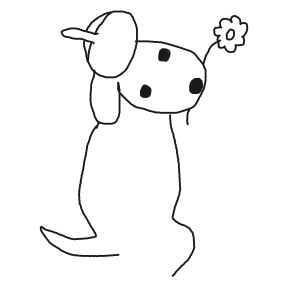
A raster sketch becomes editable paths and an inferred process—not just a traced outline.
Language changes the semantic drawing order while the measured geometry stays fixed.
Representation + artist data

Global drawing progress becomes hue; progress within each stroke becomes value. A pretrained image model generates the whole field rather than emitting strokes one at a time.
Recorded vector sequences and hierarchical region/subject annotations ground the process in commissioned artistic work.
Reorder named regions and rewrite the caption to match, while preserving natural order inside each region.
Without a stroke log, the model infers a plausible or instructed process; it does not recover an original human one.
The key idea is to make order an image-native intermediate representation. Global drawing progress becomes hue, while progress within each stroke becomes value. A pretrained image model can therefore generate the whole order field instead of autoregressively emitting strokes. We train on 47,318 drawings commissioned from 50 artists. Region and subject annotations let us permute named parts and rewrite the order caption to match, while preserving natural order inside each part. For an image without a stroke log, the model infers a process; it does not recover the original human one.The mechanism
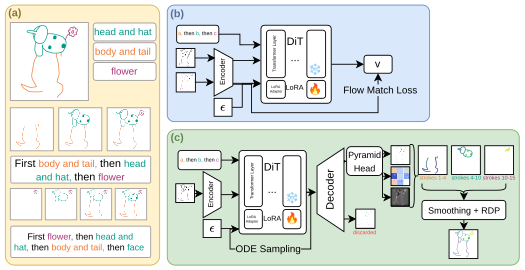
Qwen-Image-Edit + LoRA samples the codec image from text or an input sketch.
The order-native decoder predicts global arc, foreground, and stroke-instance embeddings.
Cluster, sort, smooth, and simplify into ordered vector polylines.
The useful output is not a raster animation. It is editable vector geometry whose sequence language can address.
At generation time, Qwen-Image-Edit, adapted with LoRA, samples the codec image from text or an input sketch. An order-native VAE decoder predicts a global arc field, a foreground mask, and stroke-instance embeddings. We cluster those embeddings into strokes, sort them by predicted arc, and recover smoothed vector polylines. The result is not a raster animation: it is a set of vectors whose replay order can be inspected and addressed by language.