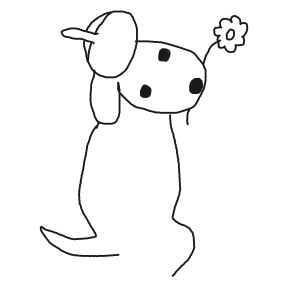
Text becomes a new ordered vector sketch, retaining the image prior’s ability to invent a subject.
NeurIPS 2026 · Creative AI · Sydney
Draw This First
From prompts or pixels to replayable,
language-directed vector drawings.
Dazhi Zhong · Rowan Bradbury · Grant Davis
Krea.ai · Bradbury Group · Wand Technologies
One ordered-vector output contract
Create. Derender. Direct.
New sketches and existing images become the same useful artifact: editable vectors with a process you can replay and control.
A raster sketch becomes editable paths and an inferred process—not just a traced outline.
Language changes the semantic drawing order while the measured geometry stays fixed.
Representation + artist data

Order becomes an image-native field
Order as color
Global drawing progress becomes hue; progress within each stroke becomes value. A pretrained image model generates the whole field rather than emitting strokes one at a time.
47,318 drawings · 50 artists
Recorded vector sequences and hierarchical region/subject annotations ground the process in commissioned artistic work.
Order supervision by permutation
Reorder named regions and rewrite the caption to match, while preserving natural order inside each region.
Without a stroke log, the model infers a plausible or instructed process; it does not recover an original human one.
The key idea is to make order an image-native intermediate representation. Global drawing progress becomes hue, while progress within each stroke becomes value. A pretrained image model can therefore generate the whole order field instead of autoregressively emitting strokes. We train on 47,318 drawings commissioned from 50 artists. Region and subject annotations let us permute named parts and rewrite the order caption to match, while preserving natural order inside each part. For an image without a stroke log, the model infers a process; it does not recover the original human one.The mechanism
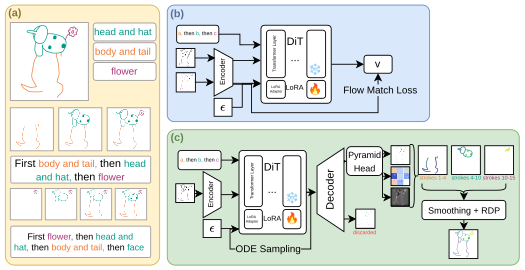
Generate. Decode. Replay.
Generate
Qwen-Image-Edit + LoRA samples the codec image from text or an input sketch.
Decode
The order-native decoder predicts global arc, foreground, and stroke-instance embeddings.
Replay
Cluster, sort, smooth, and simplify into ordered vector polylines.
The useful output is not a raster animation. It is editable vector geometry whose sequence language can address.
At generation time, Qwen-Image-Edit, adapted with LoRA, samples the codec image from text or an input sketch. An order-native VAE decoder predicts a global arc field, a foreground mask, and stroke-instance embeddings. We cluster those embeddings into strokes, sort them by predicted arc, and recover smoothed vector polylines. The result is not a raster animation: it is a set of vectors whose replay order can be inspected and addressed by language.The controlled experiment
Language moves order, not geometry
Creative Birds + Creatures · fixed input and seed · 100 drawings per condition
τ compares produced and recorded order: positive follows, negative reverses, zero is unrelated. Example: birds_7509, selected by the paper’s deterministic median rule.
This experiment isolates the order channel. On 100 held-out Creative Birds and Creatures sketches, we fix the input and seed and change only the written instruction. With no order caption, matched Kendall tau is 0.139. Asking for the recorded order raises it to positive 0.373. Reversing that same instruction drives it to negative 0.267. Across the recorded-to-reversed intervention, stroke match stays at 0.934 and mask IoU at 0.601. In other words, the instruction changes the drawing order while the measured geometry stays fixed—even when the requested order contradicts the recording.Capabilities + boundaries
A controllable process, with clear limits
Region-level instruction τ
The strongest control is between named semantic units.
QuickDraw Top-1 / Top-5
Fifty unseen categories test whether text-to-vector retains recognizable generation.
Part / pass instruction τ
Control weakens as instructions become finer and revisit more passes.
Process, not human imitation
Complex human drawings are not yet reproduced with fully human-like processes. Unrecorded processes are inferred, not recovered.
Vectorization remains lossy
Recovered paths fragment 1.7–2.5×. Local and within-unit order remain weaker than region-level control.
Order is only one channel
The representation drops timing, pressure, tilt, and brush width. Text-to-vector currently lags image derendering.
A unified, controllable interface—not a complete model of how humans draw.
Control is strongest between named regions, where instruction adherence reaches 0.838. Text-to-vector also retains recognizable generation on 50 unseen QuickDraw categories, reaching 0.75 top-one and 0.84 top-five, although generation quality currently lags derendering. Control weakens for fine-grained parts and repeated passes, and vectorization fragments strokes. Our representation records order, not timing, pressure, tilt, or brush width. This is a unified, controllable interface—not yet a complete model of how humans draw.Draw This First
An image model can generate
the process—not only the picture.
Where this can lead
Turn abundant raster sketches into synthetic ordered-vector supervision for sketch-native generative models.
A bootstrap signal, not human-process ground truth.
Dazhi Zhong · Rowan Bradbury · Grant Davis
elea@krea.ai